In today’s competitive hiring landscape, companies often need to recruit at scale without compromising on quality. This is where a well-defined Recruitment Funnel becomes essential. Whether it’s campus drives, bulk hiring, or expansion into new markets, businesses must manage thousands of applications efficiently while still identifying the best talent. A structured Recruitment Funnel for Large Hiring Campaigns helps organisations streamline the entire hiring journey – from attracting candidates to onboarding them successfully.
Instead of relying on unorganised processes, a clear funnel allows recruiters to track progress, remove inefficiencies, and improve decision-making. It ensures that every stage of hiring is measurable and optimised. The Benefits of Recruitment Funnel for Large Hiring include faster hiring cycles, better candidate experience, and improved hiring quality. By using the right strategies and tools, companies can scale their recruitment efforts smoothly while maintaining consistency and control.
In this article, we will discuss about the recruitment funnel, the key stages, benefits and optimisation strategies for large hiring campaigns.
What is a Recruitment Funnel?
A Recruitment Funnel is a step-by-step hiring framework that guides candidates through different stages, starting from awareness to final onboarding. Just like a sales funnel, it narrows down a large pool of applicants into a smaller group of qualified hires.
For large hiring campaigns, this funnel becomes even more important as it helps manage high volumes of candidates without overwhelming the recruitment team. A well-structured Recruitment Funnel for Large Hiring Campaigns ensures that only the most suitable candidates advance to each stage.
Key Stages of a Recruitment Funnel for Large Hiring Campaigns
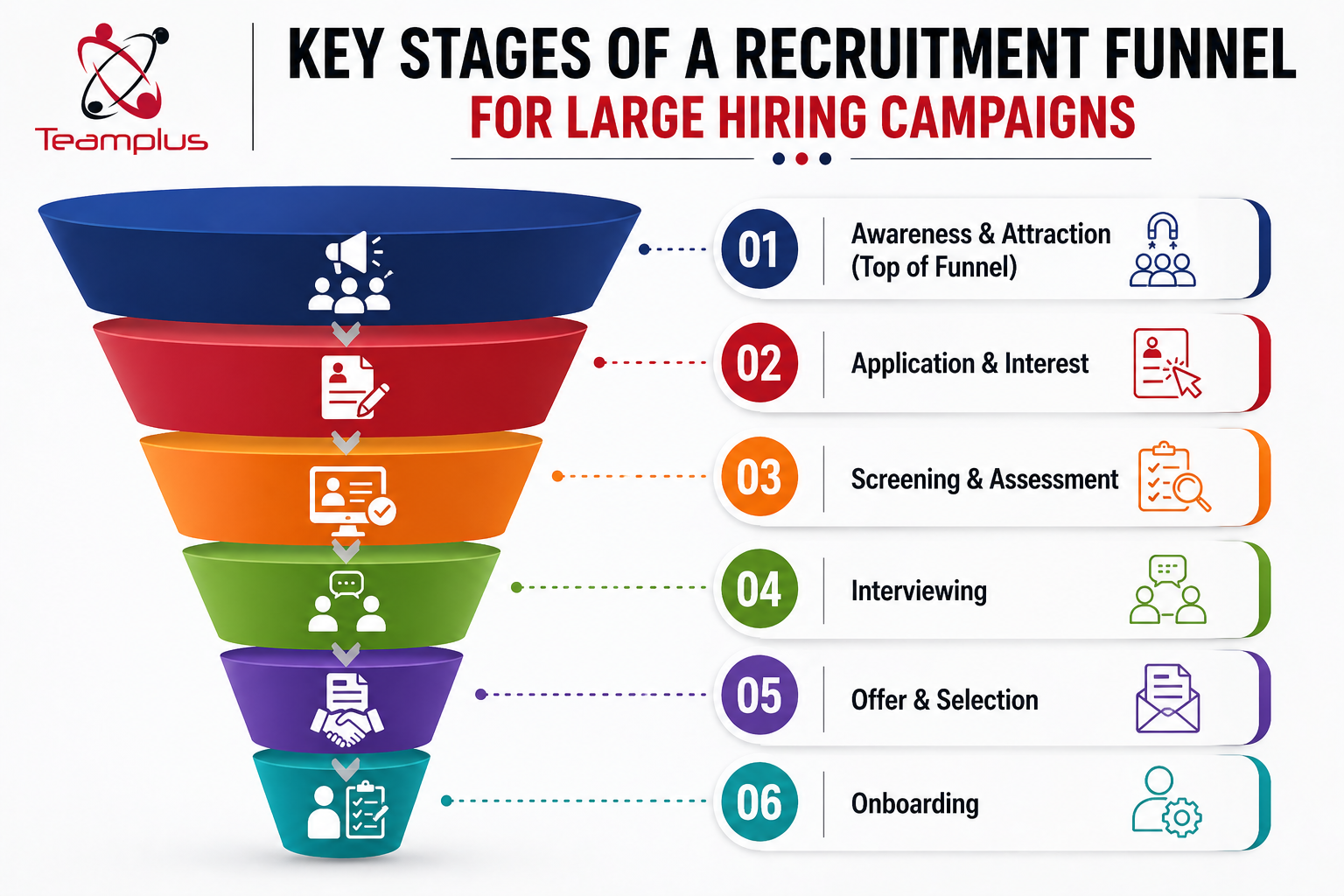
1. Awareness & Attraction (Top of Funnel)
At the top of the funnel, the focus is on reaching a wide audience and generating interest among potential candidates. Companies invest in employer branding, social media campaigns, and job portals to create visibility. Employee referrals and targeted advertisements also play a major role in attracting the right audience. This stage is not just about quantity but also about attracting candidates who align with the company’s culture and job requirements.
2. Application & Interest
Once candidates are aware of the opportunity, the next step is to convert their interest into actual applications. This stage is often where many companies lose potential candidates due to lengthy or complicated forms. A simple, mobile-friendly application process can significantly improve conversion rates. By minimising unnecessary steps and allowing quick applications, companies can ensure a smoother transition of candidates into the next stage of the Recruitment Funnel.
3. Screening & Assessment
The screening stage is where the bulk of filtering happens. Instead of manually reviewing every application, companies now rely on automated tools and AI-driven systems to shortlist candidates. Online assessments, aptitude tests, and skill-based evaluations help identify the most suitable applicants. This stage is especially important in a Recruitment Funnel for Large Hiring Campaigns, as it helps manage large volumes efficiently without compromising on quality.
4. Interviewing
The interview stage allows recruiters to evaluate candidates in depth. For large hiring campaigns, maintaining consistency is crucial, which is why structured interviews are widely used. These interviews follow a standard format, ensuring that each candidate is assessed fairly. Virtual interviews and panel discussions also help speed up the process while maintaining quality. A well-managed interview stage strengthens the overall effectiveness of the Recruitment Funnel.
5. Offer & Selection
Once the best candidates are identified, the focus shifts to converting them into employees. This stage requires speed and clarity, as delays can lead to losing top talent. Companies must present competitive offers and clearly communicate job roles, expectations, and benefits. A smooth and quick offer process reflects professionalism and plays a key role in the success of the Recruitment Funnel for Large Hiring Campaigns.
6. Onboarding
Onboarding is the final stage where selected candidates become part of the organisation. This phase is more than just documentation – it sets the tone for the employee’s journey. A structured onboarding process, along with pre-joining engagement, helps new hires feel welcomed and prepared. A strong onboarding experience not only completes the hiring process but also improves employee retention in the long run.
Also Read: How to Choose the Right Recruitment Service for Your Business
Benefits of a Recruitment Funnel for Large Hiring
Implementing a structured Recruitment Funnel for Large Hiring Campaigns offers several advantages:
Faster Hiring Process – Reduces time-to-hire by streamlining each stage
Better Quality Hires – Filters candidates effectively at every step
Improved Candidate Experience – Clear communication and smooth process
Data-Driven Decisions – Helps track performance and improve strategies
Reduced Hiring Costs – Minimises unnecessary efforts and resources
These Benefits of Recruitment Funnel for Large Hiring make it a must-have strategy for growing organisations.
Optimisation Strategies for Large Hiring Campaigns
To get the best results from a Recruitment Funnel, companies must continuously optimise their process. Tracking key hiring metrics helps identify where candidates drop off and which sources bring the best talent. This allows recruiters to focus their efforts on strategies that deliver results.
Reducing friction in the application process is another critical factor. When candidates can apply quickly and easily, the chances of drop-offs decrease significantly. At the same time, maintaining clear and timely communication throughout the process enhances the overall candidate experience.
Technology also plays a major role in optimisation. Tools like Applicant Tracking Systems (ATS), AI-based screening software, and automated scheduling systems make it easier to handle large volumes of applications. By leveraging these tools, companies can scale their Recruitment Funnel for Large Hiring Campaigns without increasing workload.
Final Thoughts
A well-planned Recruitment Funnel is the foundation of successful large-scale hiring. It provides structure, improves efficiency, and ensures that companies can attract and hire the right talent without unnecessary delays. By focusing on continuous improvement, leveraging technology, and enhancing candidate experience, organisations can make the most of their Recruitment Funnel for Large Hiring Campaigns and achieve long-term hiring success.